
11 Jun 2026. Asia
CommentsShare articleCite article

Recently, the 11 member states of the Association of Southeast Asian Nations (ASEAN) adopted a Declaration on the Right to a Safe, Clean, Healthy and Sustainable Environment.
This is an important commitment to environmental justice for the 680 million people who call this region home, a new op-ed by the former U.N. special rapporteur on human rights and the environment states, but it needs to begin implementation, he argues.
“The next step — implementation — is even more crucial,” he writes. “The ASEAN region faces enormous environmental challenges, and too often governments have failed to protect the human rights of those who are on the frontlines of those challenges.”
This article is a commentary. The views expressed are those of the author, not necessarily of Mongabay.
See All Key Ideas
The countries of the Association of Southeast Asian Nations (ASEAN) have made an important commitment to environmental justice for the 680 million people who call this region home. Now comes the hard part: putting it into practice.
Last October, ASEAN member states — Brunei, Cambodia, Indonesia, Laos, Malaysia, Myanmar, the Philippines, Singapore, Thailand, Timor-Leste, and Vietnam — adopted a Declaration on the Right to a Safe, Clean, Healthy and Sustainable Environment. They are currently in the process of drafting a regional plan of action to give it life.
The right to a healthy environment as it’s usually called is now globally accepted as a fundamental human right. ASEAN first recognized this right in 2012 in the ASEAN Human Rights Declaration. In 2022, the United Nations General Assembly proclaimed the right in a virtually unanimous vote: 161 governments voted in favor, none against, and only eight abstained. At the national level, more than 100 countries now include it in their constitutions.

Southeast Asia enjoys a rich natural heritage, like this coral reef in the Philippines, that supports the lives and livelihoods of millions of people. Image courtesy of Jett Britnell/Coral Reef Image Bank.
At the same time, international tribunals and domestic courts have made strides in clarifying what the right requires. In July 2025, the International Court of Justice, also known as the World Court, issued an opinion on climate change in which it said the human right to a healthy environment is inherent and essential for other human rights, including the right to life, the right to health, and the right to an adequate standard of living. To protect those rights, states therefore have obligations to protect the environment.
Other international tribunals have spelled out that these obligations have procedural and substantive aspects. Procedurally, they require states to protect individuals’ rights of access to environmental information, to participate in environmental decision–making, and to be able to seek judicial remedies for environmental harm. States must protect those who are exercising their rights of freedom of expression and association, even — or, rather, especially — when they are doing so in opposition to projects supported by a government or powerful businesses.
Substantively, states have to use their best efforts to provide safe air and water, protect the climate system, and conserve natural ecosystems. And they must ensure that their environmental laws and policies don’t impose disproportionate and discriminatory environmental burdens, such as exposure to hazardous waste and toxic substances, on marginalized communities.
Drawing on these developments, the ASEAN Intergovernmental Commission on Human Rights (AICHR) convened a series of meetings at which representatives of governments and of civil society discussed how to clarify what the right means for people living in the region, and to support the drafting of the regional declaration. This process was pathbreaking in itself: it was the first time that ASEAN instituted a working group that included civil society and experts. Although governments still had the final word, and civil society organizations did not achieve everything they sought — especially clearer references to the rights of Indigenous peoples and explicit recognition of environmental human rights defenders — the declaration clearly and significantly reflects their input.
It also breaks new ground globally. Governments had never before tried to elaborate on all aspects of the right to a healthy environment. The closest precedents are regional treaties in Europe, and in Latin America and the Caribbean, which set out the obligations of states with respect to the procedural rights of access to information, participation, and remedy. However, they do not address the substantive elements of the right to a healthy environment.

One of the more widely known environmental justice issues in Southeast Asia is the jailing of five Mother Earth Cambodia activists. From left: Ly Chandaravuth (26), Long Kunthea (28), Phuon Keoraksmey (25), Thun Ratha (34) and Yim Leanghy (37) say farewell to supporters before entering court on May 29, 2024. The Phnom Penh Court of Appeals recently postponed their appeal request indefinitely. Image by Gerry Flynn for Mongabay.
By contrast, the ASEAN Declaration reflects the evolving understanding of all aspects of the relationship between human rights and environmental protection. It commits ASEAN governments to promote and foster access to information, meaningful public participation, and access to justice, including for people in vulnerable situations. But it also promises to develop and implement environmental measures that take into account international standards, to implement multilateral environmental agreements, to promote environmental education, and to ensure “equal and effective” protection and discrimination against human rights violations.
The preamble acknowledges the need for “sufficient and effective protection for all, including persons working to promote and protect the right to a safe, clean, healthy and sustainable environment.” Although this doesn’t refer explicitly to environmental human rights defenders, as many civil society organizations sought, it does provide a basis for further efforts to recognize and protect them.
Moreover, the declaration strongly encourages nonstate actors and businesses to respect and promote the right to a healthy environment, and to use risk assessment tools such as environmental impact assessments. The ASEAN states promise to enhance collaboration with one another to share environmental information and knowledge, and enhance cooperation with relevant stakeholders to address environmental issues.
A group of U.N. special rapporteurs and other experts welcomed the declaration as a “historic step” for human rights and environmental protection in the region. But the next step — implementation — is even more crucial. Unlike the European and Latin American treaties, the ASEAN Declaration is not legally binding in itself, nor does it provide much detail on exactly how the ASEAN states should carry out their commitments. However, ASEAN governments recognized that the declaration itself is only the first step. In the declaration, they tasked the AICHR, in consultation with other relevant ASEAN bodies, to develop “an ASEAN-owned and ASEAN-led Regional Plan of Action.”
The preamble acknowledges the need for “sufficient and effective protection for all, including persons working to promote and protect the right to a safe, clean, healthy and sustainable environment.” Although this doesn’t refer explicitly to environmental human rights defenders, as many civil society organizations sought, it does provide a basis for further efforts to recognize and protect them.
Moreover, the declaration strongly encourages nonstate actors and businesses to respect and promote the right to a healthy environment, and to use risk assessment tools such as environmental impact assessments. The ASEAN states promise to enhance collaboration with one another to share environmental information and knowledge, and enhance cooperation with relevant stakeholders to address environmental issues.
A group of U.N. special rapporteurs and other experts welcomed the declaration as a “historic step” for human rights and environmental protection in the region. But the next step — implementation — is even more crucial. Unlike the European and Latin American treaties, the ASEAN Declaration is not legally binding in itself, nor does it provide much detail on exactly how the ASEAN states should carry out their commitments. However, ASEAN governments recognized that the declaration itself is only the first step. In the declaration, they tasked the AICHR, in consultation with other relevant ASEAN bodies, to develop “an ASEAN-owned and ASEAN-led Regional Plan of Action.”
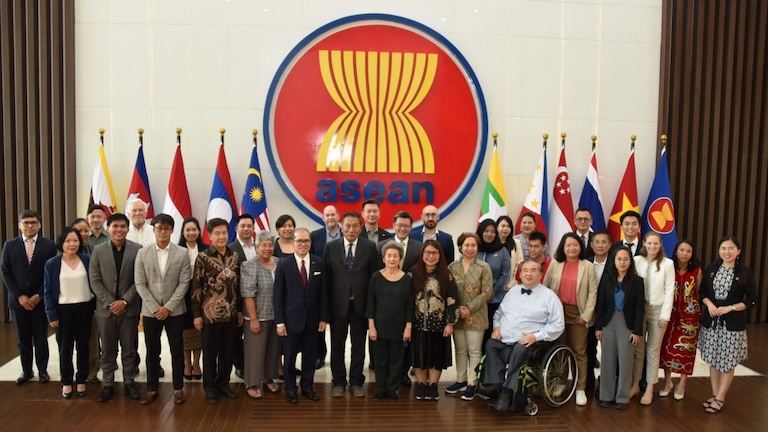
The ASEAN environmental working group.
This is essential. The ASEAN region faces enormous environmental challenges, and too often governments have failed to protect the human rights of those who are on the frontlines of those challenges.
In December 2025, the AICHR held the first meeting to consult on the potential way forward for the plan of action, again with the inclusion of civil society organizations. It hopes to finalize this process by the end of 2026. As these discussions go forward, AICHR should ensure the plan of action sets out, in practical detail, what the ASEAN governments should do to make the right to a healthy environment a living reality.
Among other things, an effective regional plan of action would set out guidance on how the ASEAN states should provide environmental information, facilitate participation in decision-making, and ensure effective access to justice; protect the rights of freedom of expression, association, and peaceful assembly in environmental matters; draw on relevant international environmental, health, and safety standards in developing and implementing environmental laws; and protect the most vulnerable from environmental harm, through the development of their own national action plans.
A plan of action that does all of this would not only be of incalculable benefit to the people of the ASEAN region, but it could provide a model for the rest of the world.
In December 2025, the AICHR held the first meeting to consult on the potential way forward for the plan of action, again with the inclusion of civil society organizations. It hopes to finalize this process by the end of 2026. As these discussions go forward, AICHR should ensure the plan of action sets out, in practical detail, what the ASEAN governments should do to make the right to a healthy environment a living reality.
Among other things, an effective regional plan of action would set out guidance on how the ASEAN states should provide environmental information, facilitate participation in decision-making, and ensure effective access to justice; protect the rights of freedom of expression, association, and peaceful assembly in environmental matters; draw on relevant international environmental, health, and safety standards in developing and implementing environmental laws; and protect the most vulnerable from environmental harm, through the development of their own national action plans.
A plan of action that does all of this would not only be of incalculable benefit to the people of the ASEAN region, but it could provide a model for the rest of the world.
John Knox is the Henry C. Lauerman Professor of International Law at Wake Forest University. From 2012 to 2018, he served as the first UN Special Rapporteur on human rights and the environment.
Banner image: A full-circle rainbow arcing over a vast oil palm plantation in Jambi, Indonesia, carved out of what was once native rainforest. Image by Rhett A. Butler/Mongabay.
